|
One outstanding classic yacht of America’s Cup fame is
now available for restoration in our yard. The 12-metre “Gretel” was
challenger to the Cup in 1962 and, at the same time, the first
Australian 12-metre ever. Designed by Alan Payne, this boat was
quicker than the defender, the Philip Rhodes design “Weatherly”.
It was in this regatta that the Americans lost a Cup race for
the first time since the races between “Endeavour” and “Rainbow” in
1934. This challenge proved to become serious and quite thrilling,
but in the end the Americans successfully defended the Cup due
to the superior performance of “Weatherly’s” crew
and skipper Emil “Bus” Mosbacher. “The wizard” Mosbacher
was quite rightly famous as being one of the best helmsmen of
his time; 1967 he defended the Cup a second time, now with the
12-metre “Intrepid” against “Dame Pattie” from
Australia.
After the America’s Cup regatta of 1962, the fast “Gretel” served
as trial horse for several following Cup challenges. Later she was sold
to Europe and sailed many years in Italy. It was here that she was found
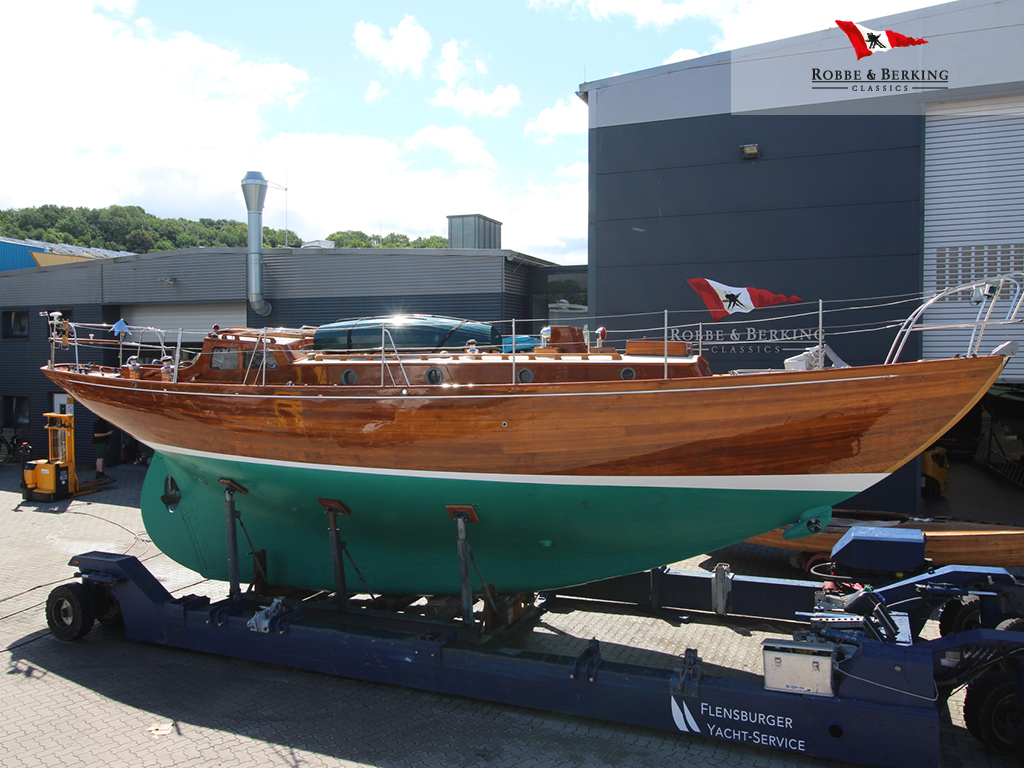
by “Robbe & Berking Classics” and transported to Flensburg
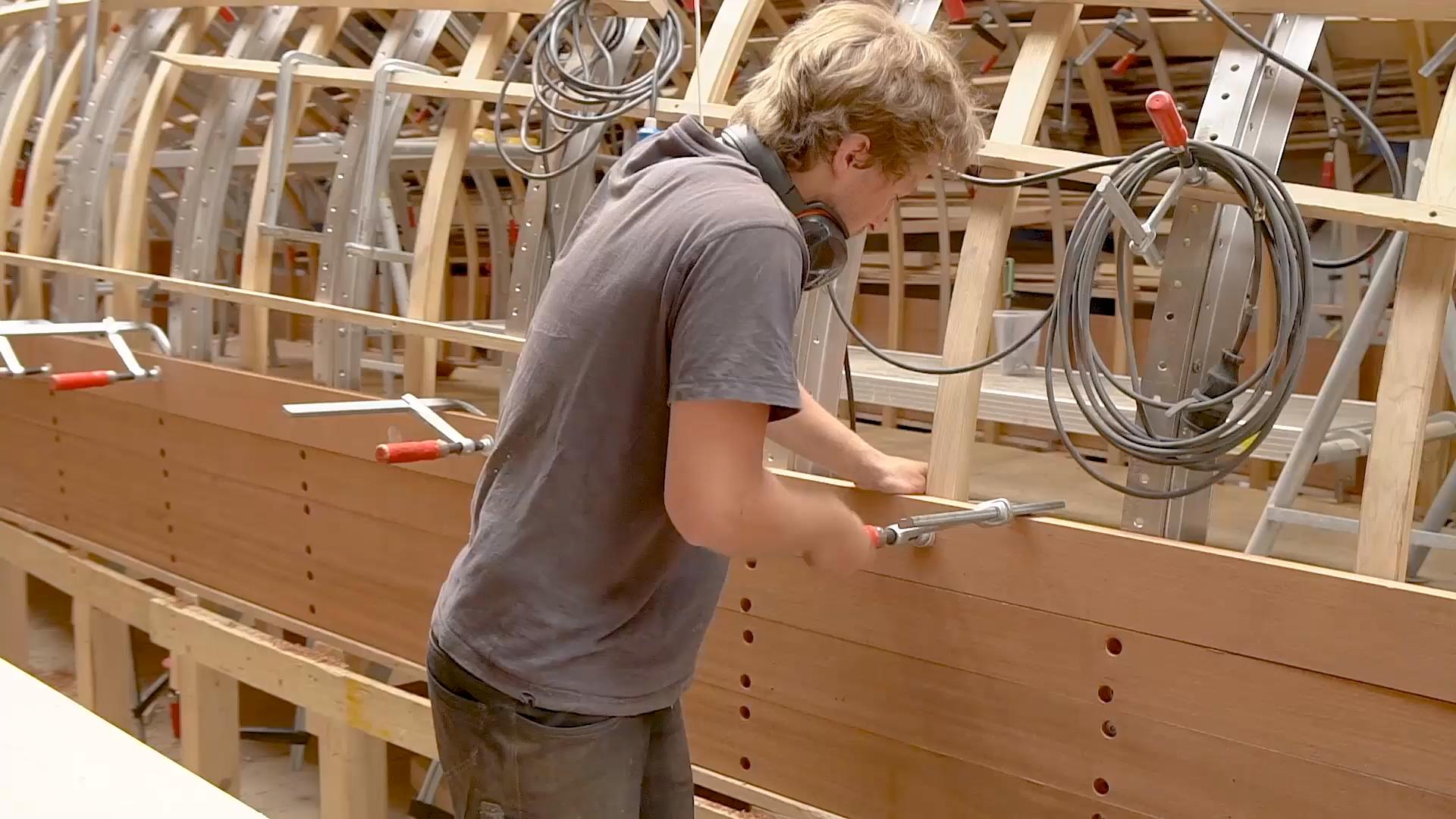
Germany, for a complete restoration. “We aim to bring this historic
yacht back to the original condition of 1962”, said Oliver Berking,
proprietor of the boatyard “Robbe & Berking Classics”. “This
is a unique piece of yachting history that must be kept alive!”
About the boat: Length over all 69.4 ft / 21,16 m; beam 11.7 ft / 3,58
m; draft 8.76 ft / 2,67 m; displacement 26,7 tons; sail area 1796.5
sq-ft / 166,9 qm; designed by Alan Payne, built from wood on steel frames.
The America’s Cup challenge of 1962 was well prepared and came
very close to being successful. Sir Frank Packer, the Australian publisher,
announced his plans for the America’s Cup as early as 1958. He
then went on to charter “Vim”, the fastest 12-metre at the
time for four years for his crew to train on her. “Vim”,
designed by Olin Stephens, had already served as the trial horse for
the Cup defender of 1958, “Columbia”. Packer then let his
designer Alan Payne do extensive research for the new 12-metre design
at the Stevens Institute in New York, where Payne also already used
tank testing.
Payne’s 12-metre design was full of new ideas. One significant
innovation was the grinder system, where the main winches were linked
together and driven by foot pedals. This increased the efficiency when
tacking enormously.
The fist Australian 12-metre ever was launched on 19th February 1962,
seven months before the Cup races were scheduled. Nine days later, the
boat was christened “Gretel” in honour of Frank Packer’s
deceased wife. Even the first few test runs against “Vim” suggested
that “Gretel” was a very fast boat. In late May, both yachts
were shipped to the US where “Gretel” later delivered a
hard and worthy fight for the Cup, much closer in fact than the overall
results (4-1) may imply. The races were very close, the Australians
won once.
In the end, the Americans prevailed once more, due to the superior
performance of “Weatherly’s” crew and skipper, Emil “Bus” Mosbacher.
He was justifiably regarded as one of the best helmsmen of his time,
in 1967 he defended the Cup once more, this time in the 12-metre “Intrepid” against “Dame
Pattie” from Australia.
As the Australians clearly had the better boat in 1962, the Americans
changed the rules so that all future challengers were barred from American
design or built technology.
After the Cup races, “Gretel” served as trial horse for
several challenges to come: 1967 for “Dame Pattie” and in
1970 for “Gretel II” which was Frank Packers second challenge.
In the end she even sailed in the first “Southern Cross” team
in 1975.
From 1973 to 1974 she belonged to “Yanchep Estates Pty. Ltd.“,
her home port was given as Perth and Yanchep. In 1975, the “Southern
Cross America’s Cup Challenge Association, Ltd.“ owned her,
from 1976 to 1979 she belonged once more to the “Gretel Syndicate” and
in 1980, she was taken out of Lloyd’s Register. From 1982 to 1994
she worked as a charter yacht in the Whitsundays, later she was sold
to Europe where she spent many years in Italy. It was here that she
was found by “Robbe & Berking Classics” and transported
to Flensburg Germany, for a complete restoration. “We aim to bring
this historic yacht back to the original condition of 1962”, said
Oliver Berking, proprietor of the boatyard “Robbe & Berking
Classics”. “This is a unique piece of yachting history that
must be kept alive!”
Alan Payne (1921-1995) was a brilliant naval architect who designed “Gretel” and “Gretel
II”. He had studied naval architecture at Sydney Technical College
and the University of New South Wales, and in 1945 was the only Australian
naval architect to devote all of his business to yacht building, both
sail and power. His 55 foot “Solo” won the Sydney Hobart
race in 1955. Having created fast lines for numerous racing craft, he
set to work on a four year project in which he analysed the lines of “Vim”,
America’s best trial horse brought to Australia by Sir Frank Packer.
Payne proceeded to test a total of 30 models towards developing “Gretel’s” design. “Gretel” was
hugely admired for her superiority in fast downwind sailing. This quality
won a race for Australia and nearly a second in a very tight series.
In 1970, Payne designed “Gretel II” for Packer and skipper
James Hardy. The new design proved to be an even more dangerous challenger.
For his tremendous dedication to America’s Cup designs Alan Payne
is selected for membership in the America’s Cup Hall of Fame.
Alexander “Jock” Sturrock was born in Melbourne on May
14 in 1915 and died on July 11 in 1997. He was 47 when he steered “Gretel” in
the 1962 races. In that year he was Australian of the year, Australian
Yachtsman of the year and Australian Sportsperson of the year. In 1975
he was appointed a Member of the Order of the British Empire (MBE) for
services to yachting. In 1985, he was elected one of the five inaugural “Legends
of Australian Sports” on the establishment of the Sports Australia
Hall Of Fame. Jock won over four hundred national and state championship
yachting races. He won his first Australian yachting championship in
the 12 foot Cadet dinghy “Monsoon” in 1932 at the age of
12. At 18, he helped pioneer the introduction of the International Star
Class into Australia, and won the first eight Australian Championships
in that class (between 1935 and 1947). He was three time Australian
6-Metre class champion (1946, 1947 and 1949), three time Australian
Dragon Class Champion (1953/1954, 1954/1955 and 1955/1956) and two time
Australian 5.5-Metre class championship (1956 and 1959). He represented
Australia in the Olympic Games 1948 in London (Star Class), 1952 in
Helsinki (Dragon Class), 1956 Melbourne (Bronze Medal, 5.5-Metre Class)
and 1960 in Rome (5.5-Metre Class). He was the Australian flag bearer
at the opening ceremony of the Rome Olympic Games.
He achieved international recognition when he skippered Australia’s
first challenge for the Americas Cup in 1962. Although defeated
4 to 1 by “Weatherly”, “Gretel’s” victory
in the second race was the first by challenger since 1934,
and is widely recognised as the first of the events that
resurrected the America’s Cup as an international sporting
competition. He also skippered “Dame Pattie”,
Australia’s second America’s Cup challenger in
1967, which was beaten 4 to 0 by the highly controversial
defender “Intrepid”. Later, he represented Australia
multiple times as an ocean racing skipper in the Admiral’s
Cup and the Kenwood Cup, and managed two successful Australian
campaigns for the “Little America’s Cup” (International
C-Class Catamaran Challenge). Between 1972 and 1980 he was
a member of the Olympic Fund Raising Committee.
Frank Packer (Sir Douglas Frank Hewson Packer, 3.12.1906
- 1.5.1974) was an Australian media proprietor who controlled
Australian Consolidated Press and the Nine Network .In 1923,
Packer became a cadet journalist on his father’s paper, “The
Daily Guardian”. Only four years later he was a director
of the company. In 1933 Packer started the Australian “Women’s
Weekly” and then transformed “The Daily Telegraph” into
one of Australia’s leading newspapers. When television
was introduced to Australia in 1956, Packer became a significant
television network shareholder. In 1972 Packer sold his newspaper
flagship to Rupert Murdoch, a decision he reportedly regretted.
Packer was boxer, golfer, polo player and a keen yachtsman.
|